



I truly want my students to succeed. However, success in study and learning is not automatic or easy. It takes a lot of effort. In order to help in the sometimes challenging task of learning, I have assembled a few helpful hints to make your study more efficient and profitable.

Below you will find a number of sections dealing with various aspects of study and how to do it more effectively and efficiently. I hope and pray that you would not just survive, but thrive in your learning experience- growing in every way and fulfilling your God given destiny with excellence and all the diligence such a high calling deserves.

Click each banner to view that section. And then click the appropriate icons and links to expose more material and information as you would like to explore in more depth. Please be encouraged to explore and use these suggestions.

trigger icon
Disciplines of Study
Click Here to  close open

Click the plus and minus icons with each item below to see more or less information

Or you may push the buttons below to expand or collapse the every item at once:

Quality education takes effort
No matter what your expectations for learning are, many students find the coursework more difficult and time consuming than they expected. Good education requires a lot from students because we know you have a high calling, not a mediocre calling
It is also a common experience that the excitement of education wears off. When the honeymoon period of the new experience is over, you will still have textbooks to read and assignments to write, whether you feel like doing them or not.
It seems to often be God's manner to put us in difficult situations, not to crush us, but to grow us. We grow when we are stretched - when we meet resistance. No pain, no gain. If it were easy, everyone would do it. You need to be honest with yourself that it may get difficult. You also need to decide in advance that you will rise to the challenge and learn discipline and grow in character.
You should make devotion and study a priority
First of all, devotion and study are a priority! Growing in discipleship and academics is (or should be) the reasons you are pursuing more education. They are near the heart of God for your growth and effectiveness. God calls all of us to a lifetime of discipline and purpose many times in Scripture. Our love for Him should be shown in our obedience to Him in this area of our lives (along with other areas).
Discipline does not come easy or naturally. Just as no one becomes a great athlete or artist without putting in hours of training, being a growing disciple takes work. You cannot expect to get all God has for you and all that the classes offer without actively taking hold of it. You cannot study only when you feel like it, because you will not always feel like it when you should, and there will always be worthless things calling for your attention. You cannot pray only when it is convenient, because it is not convenient enough. You cannot be disciplined only when there is nothing better to do, because there is always something else to do. You have to make the time to do what is right and what is right does not always feel right.
Your flesh is fighting against your success in discipline. You need to recognize and overcome your fallen tendency to take the easy way. The way of discipline is not attractive to our sinful nature and it always fights and whines against discipline. It takes an act of the will to tell our flesh to shut up so that we can do what is right no matter what.
Not only does our fallen human nature fight against discipline, but we have an active enemy fighting against us. We need to recognize that our enemy does not want us to fulfill God's purposes and is constantly, actively fighting against us. We must realize that we are in a war and always be active as well.
Before it seems like we need to do it all ourselves, let us remember that true victory comes form God alone, and He is able to give us victory. We cannot do it by ourselves. We cannot overcome either our sinful nature or the enemy of our souls in our own strength. Only as we rely on the Lord and fight in His strength do we find discipline and victory.
However, that does not mean that we have no part to play. Discipleship is a partnership - where we do our part with all our might, and God does His part. Phil. 2:12-13 says - "Work out your salvation with fear and trembling. Because it is God who is working in you both to will and to do."
Think about the future benefit with hope and faith
Discipline is really about hope and faith. Just as an athlete goes through painful workouts, not for the workout itself, but looking forward to the benefit that the workout will give when it comes to gametime, so also discipline is not so much for the time you spend learning, as it is an investment in the present and future calling God has for you.
Discipline is not about good grades or pleasing teachers. It is about becoming a person of discipline and character. You are right now becoming the person you will be forever. What kind of person are you becoming?
We need to break away from the tyranny of the urgent and enticing, and use our time and energy according to what is important in terms of God's eternal perspective.
We need to trust in delayed gratification. Delayed gratification is putting off the reward until later - trusting that God will indeed reward as He has promised. For instance, those who spend their money as soon as they get it will always be broke. But those who deny themselves something in order to save the money for the future, will build wealth over time. It is immediately rewarding to go watch a movie and hang out with friends. It is not always immediately rewarding to study and work on learning something new. However, in making that decision, you need to take into consideration the long term effects of the decision and what will actually bring the most (and the most lasting) benefit.
If you study consistently over the long haul, you will learn more and get more benefit than if you try to cram everything in one intense session. Ultimately, the first option is both easier and more rewarding. All it takes is the foresight to get ahead by working on your learning instead of wasting your life on things that are not profitable.
That does not mean that you should not have friends or fun (see the section on balancing study and life). It just means that a disciplined person will give the time to friends that should be given to friends, the time to study that should be given to study, and the time to God that should be given to God. There are a million thing that will tempt you to go against your priorities for the short-term reward, but you much conquer them by focusing instead on the long-term reward of doing what is right.
Ultimately, discipline is about faith. There are many Scriptures about the need for discipline and the fact that God will ultimately reward a disciplined person. We need to ask ourselves, "Is God trustworthy?", "Can I depend on God to follow through with His promises - bringing the reward in the right time?" If we say yes, then we should live lives of discipline, trusting God that it is the best and most rewarding choice.
Concentrate on the Biblical purpose of learning
Negative Contrasts
The Bible occasionally speaks of negative types of knowledge that are not functioning as God intended His people to think.
Prideful Control
Our knowing things is not intended primarily for us to master and control them in a selfish and tyrannical fashion
Our knowledge is not primarily to serve as a source of personal pride in our own glory and knowledge.
1 Cor. 8:1 says that this kind of knowledge puffs up [our pride] but does not build up. And the persons who thinks he knows something in this manner does not yet know as he ought to know. Therefore, if our knowledge only leads to prideful self-importance and delighting in our own accomplishment rather than delighting in the knowledge itself and the God-given benefit it can bring, we have attained the wrong kind of knowledge.
Without Obedient Application
In a similar way, the Bible speaks of a kind of intellectual apprehension without the appropriate response as being a severely defective kind of knowledge.
James 1:22 commands us not merely to hear the Word, but also to do what it says. If we do the former without the latter, this verse says that we are deceiving ourselves.
And the next few verses use the example of a man looking in a mirror and then forgetting what he looks like to contrast those who obey what they learn with those who do not. And James concludes that the person who learns and also properly responds in obedience to what they learn will be blessed (verse 25).
Therefore, learning without putting that knowledge into practice in the appropriate way is not the Biblical ideal and purpose of learning.
Positive Purposes and Benefits
More often, the Bible speaks of the positive aspects of learning and knowledge.
Rather than using knowledge to control or puff up our pride, we can truly understand God's Word and world in order to embrace and revere the truth and live in conformity with it.
The great astronomer Johannes Kepler spoke of this kind of knowledge as "Thinking God's thoughts after Him."
We can conform our understanding of things to God's truth and therefore have a more accurate and complete picture of reality in order to live more successfully and blessedly.
2 Tim. 3:16-17 tells us that God's Word is profitable for teaching, reproof, correction, and training in righteousness.
"Teaching" is the positive side of intellectual thinking and doctrine. This is pursuing and growing in the correct things that we should think and the overall worldview and attitude we should have toward these things.
"Reproof" is the negative side of intellectual thinking and doctrine. This is avoiding, rejecting, and correcting the incorrect, mistaken, inadequate, or outright false things that we should not think or believe. This is fixing broken worldviews and attitudes and bringing every falsehood into conformity with Christ. As Paul said in 2 Cor. 10:4, "We demolish arguments and every pretension that sets itself up against the knowledge of God, and we take captive every though to make it obedient to Christ."
"Correction" is the negative side of actions and lifestyle. This is avoiding, rejecting, and correcting the incorrect and sinful actions that we should not do and/or that we should work to dissuade and prevent others from doing. This is correcting unjust and unwise behavior and habits and replacing them with those kind of lifestyle activities that come from sound doctrine and are in conformity with the Gospel and all of God's truth (1 Tim. 1:10-11).
"Training in righteousness" is the positive side of actions and lifestyle. This is pursuing and growing in the correct and godly actions that we should do and encourage others to do. This is living in a way that comes from sound doctrine and is in conformity with the Gospel and all of God's truth.
I would add that these four purposes are true and appropriate (though to a lesser extent) applications of the things we learn from all of God's world. If it is true knowledge, understood correctly and in the right priorities and proportions, it can be applied in all of these ways as well.
It is noteworthy that the great commission in Matt. 28:16-20 contains the phrase "...teaching them to obey all I have commanded..." as a key part of the way we can fulfill this commission of making disciples. That is because the idea of "discipleship" is inseparable from the idea of training. The word discipleship is actually a synonym for training. And discipleship to Jesus is a shorthand way to say that we live in an apprenticeship relationship to Him, learning from Him how to live in every part of life and eternity, taking on His mindset and understanding, and imitating Him (as much as humanly possible) in His goals, attitudes and actions.
And in 1 Timothy 4:7-16, Paul commands Timothy to train in godliness and to train others in these things as well. Training in godliness is more valuable than physical training (though Paul does not disparage this). Therefore Timothy was commanded to consistently learn and grow, paying close attention both to his doctrine and his lifestyle. And he was to teach and command these things to others, so that they also could grow in the same ways, and for the same benefits.
Overall Functions of Learning
Worldview, personal, and community formation
Worldviews are like eyeglasses or contact lenses: in that they shape the way we see the world, which is the basis on which we respond to the world around us. If you have the correct glasses, you will see everything clearly and accurately. If you have bad glasses, you will bump into things and fall down.
Good learning forms our worldview in a positive way. Of course, bad learning will distort our worldview. A Christian worldview will help us to think about all of life accurately and comprehensively - that is, from a God-centered perspective. To the extent that we have a solid, Biblical worldview, it will correctly form and inform our beliefs: what we think is true. And those valid beliefs will positively influence our values: what we think is good and worthwhile. And those values will positively shape our behaviors: how we live.
And good learning forms us personally. We all are constantly learning and growing in our knowledge, skills, and values. If I learn a "fact" or opinion that is untrue, that actually diminishes my knowledge and may lead to disaster. If I learn the wrong way to do something, or a bad habit, I will have to unlearn these things in order to be successful. And if I desire harmful things, I will be harmed if I attain them.
And in the opposite case, if someone learns a true fact and rightly connects it with its proper implications, or learns a valuable skill, or gains an appreciation and desire for something worthwhile and good, that person gets better and grows more blessed. And to the extent that we learn and conform ourselves to God and His truth, we are truly the most blessed for all eternity. Learning can be the means to tremendous personal growth and happiness.
In the same way that this works for individuals, it also works for communities and social groups. If the group as a whole grows in true knowledge, skills, and values, everyone benefits. And the opposite is true. But in addition to that, these things can draw the group toward greater unity and harmony, as they all share the same understanding of things and work together along the same lines, instead of pursuing opposite and contradictory directions and goals, built on contradictory understandings. Imagine a group of athletes that agree about which sport they are playing, about the rules of the game, about their individual roles on the team and how to successfully score. They would almost certainly win over another group of athletes characterized by none of these things.
Education has always been one of the primary means of fostering community cohesion and training outsiders and new generations how to fit in well to the community. And a lack of these things is corrosive to community and societal health.
Truth and its application
The universe is the way that it is, regardless of our understanding and opinion of it.
As the old saying goes, "Reality always wins."
Therefore, the better we learn, understand, and conform to the truth of reality, the better we will be able to live successfully in every part of life.
And this is especially true about the reality of God and His place in our lives.
Accurately knowing the truth about the world around us, and having a mindset and worldview that is in conformity with reality will enable us to live wisely.
Knowledge gives us wisdom, which leads us to live well, in conformity with God's character and the reality of His creation, which give us success in every part of life.
Therefore, accurate knowledge and a heart and character in conformity with truth is extremely helpful for success in multiple ways.
When we learn the truth and apply it wisely, we reap the various benefits of learning to the glory of God.
Training the next generations
The Bible also stresses that our learning is not for ourselves alone.
That does not just mean that other people can be blessed by our application of true knowledge, or harmed by our false knowledge or misapplication of the truth (though these are valid truths).
The Bible often stresses that the knowledge and wisdom which we learn can be passed on to others, so that they can reap the same benefits.
This applies especially to the next generations.
In Deuteronomy chapter 6 (among other places), it stresses that a key task of parents is to pass on the faith to their children, teaching them various things in various ways, and making their proper education a priority.
In the pastoral epistles (among other places), it often stresses passing on the truth to other, so they can live as effective disciples, and so they also can teach others.
Teaching is a key skill and function of leaders in the New Testament (though not the only requirement). Therefore, the passing on and multiplication of the truth and faithful living is extremely important.
In history, whenever God's church has neglected solid education, training, and discipleship in character, the church and society have been weakened and worsened.
Whenever genuine revival has happened throughout history, there has been a corresponding rediscovery and re-emphasis on faithful learning and passing on of the truth.
Therefore, for all these reasons, learning is an important part of Christian life. And a growing, faithful Christian will be a life-long learner.
Meditate on the following Scriptures, which teach the need and benefit of discipline
Psa. 90:12
Teach us to number our days aright, that we may gain a heart of wisdom.
Prov. 1:5
Let the wise listen and add to their learning, and let the discerning get guidance
Prov. 2:1-6
My son, if you accept my words and store up my commands within you,
turning your ear to wisdom and applying your heart to understanding,
and if you call out for insight and cry aloud for understanding,
and if you look for it as for silver and search for it as for hidden treasure,
then you will understand the fear of the LORD and find the knowledge of God.
For the LORD gives wisdom, and from his mouth come knowledge and understanding.
Prov. 4:1-27
Listen, my sons, to a father's instruction; pay attention and gain understanding.
I give you sound learning, so do not forsake my teaching.
When I was a boy in my father's house, still tender, and an only child of my mother,
he taught me and said, "Lay hold of my words with all your heart; keep my commands and you will live.
Get wisdom, get understanding; do not forget my words or swerve from them.
Do not forsake wisdom, and she will protect you; love her, and she will watch over you.
Wisdom is supreme; therefore get wisdom. Though it cost all you have, get understanding.
Esteem her, and she will exalt you; embrace her, and she will honor you.
She will set a garland of grace on your head and present you with a crown of splendor."
Listen, my son, accept what I say, and the years of your life will be many.
I guide you in the way of wisdom and lead you along straight paths.
When you walk, your steps will not be hampered; when you run, you will not stumble.
Hold on to instruction, do not let it go; guard it well, for it is your life.
Do not set foot on the path of the wicked or walk in the way of evil men.
Avoid it, do not travel on it; turn from it and go on your way.
For they cannot sleep till they do evil; they are robbed of slumber till they make someone fall.
They eat the bread of wickedness and drink the wine of violence.
The path of the righteous is like the first gleam of dawn, shining ever brighter till the full light of day.
But the way of the wicked is like deep darkness; they do not know what makes them stumble.
My son, pay attention to what I say; listen closely to my words.
Do not let them out of your sight, keep them within your heart;
for they are life to those who find them and health to a man's whole body.
Above all else, guard your heart, for it is the wellspring of life.
Put away perversity from your mouth; keep corrupt talk far from your lips.
Let your eyes look straight ahead, fix your gaze directly before you.
Make level paths for your feet and take only ways that are firm.
Do not swerve to the right or the left; keep your foot from evil.
Prov. 5:11-14
At the end of your life you will groan, when your flesh and body are spent.
You will say, "How I hated discipline! How my heart spurned correction!
I would not obey my teachers or listen to my instructors.
I have come to the brink of utter ruin in the midst of the whole assembly."
Prov. 8:4-11
To you, O men, I call out; I raise my voice to all mankind.
You who are simple, gain prudence; you who are foolish, gain understanding.
Listen, for I have worthy things to say; I open my lips to speak what is right.
My mouth speaks what is true, for my lips detest wickedness.
All the words of my mouth are just; none of them is crooked or perverse.
To the discerning all of them are right; they are faultless to those who have knowledge.
Choose my instruction instead of silver, knowledge rather than choice gold,
for wisdom is more precious than rubies, and nothing you desire can compare with her.
Prov. 10:4
Lazy hands make a man poor, but diligent hands bring wealth.
Prov. 12:1
Whoever loves discipline loves knowledge, but he who hates correction is stupid.
Prov. 12:11
He who works his land will have abundant food, but he who chases fantasies lacks judgment.
Prov. 12:14
From the fruit of his lips a man is filled with good things as surely as the work of his hands rewards him.
Prov. 12:24
Diligent hands will rule, but laziness ends in slave labor.
Prov. 13:4
The sluggard craves and gets nothing, but the desires of the diligent are fully satisfied.
Prov. 13:14
The teaching of the wise is a fountain of life, turning a man from the snares of death.
Prov. 14:23
All hard work brings a profit, but mere talk leads only to poverty.
Prov. 15:19
The way of the sluggard is blocked with thorns, but the path of the upright is a highway.
Prov. 16:20
Whoever gives heed to instruction prospers, and blessed is he who trusts in the LORD.
Prov. 18:9
One who is slack in his work is brother to one who destroys.
Prov. 19:5
He who gets wisdom loves his own soul; he who cherishes understanding prospers.
Prov. 19:20
Listen to advice and accept instruction, and in the end you will be wise.
Prov. 21:5
The plans of the diligent lead to profit as surely as haste leads to poverty.
Prov. 21:25
The sluggard's craving will be the death of him, because his hands refuse to work.
Prov. 22:29
Do you see a man skilled in his work? He will serve before kings; he will not serve before obscure men.
Prov. 23:12
Apply your heart to instruction and your ears to words of knowledge.
Prov. 23:23
Buy the truth and do not sell it; get wisdom, discipline and understanding.
Prov. 24:33-34
A little sleep, a little slumber, a little folding of the hands to rest--
and poverty will come on you like a bandit and scarcity like an armed man.
I Cor. 9:24-27
Do you not know that in a race all the runners run, but only one gets the prize? Run in such a way as to get the prize.
Everyone who competes in the games goes into strict training. They do it to get a crown that will not last; but we do it to get a crown that will last forever.
Therefore I do not run like a man running aimlessly; I do not fight like a man beating the air.
No, I beat my body and make it my slave so that after I have preached to others, I myself will not be disqualified for the prize.
Eph 5:15-16
Be very careful, then, how you live-- not as unwise but as wise,
making the most of every opportunity, because the days are evil.
I Tim. 4:8
For physical training is of some value, but godliness has value for all things, holding promise for both the present life and the life to come.
I Tim. 4:12-16
Don't let anyone look down on you because you are young, but set an example for the believers in speech, in life, in love, in faith and in purity.
Until I come, devote yourself to the public reading of Scripture, to preaching and to teaching.
Do not neglect your gift, which was given you through a prophetic message when the body of elders laid their hands on you.
Be diligent in these matters; give yourself wholly to them, so that everyone may see your progress.
Watch your life and doctrine closely. Persevere in them, because if you do, you will save both yourself and your hearers.
2 Tim. 2:3-7
Endure hardship with us like a good soldier of Christ Jesus.
No one serving as a soldier gets involved in civilian affairs-- he wants to please his commanding officer.
Similarly, if anyone competes as an athlete, he does not receive the victor's crown unless he competes according to the rules.
The hardworking farmer should be the first to receive a share of the crops.
Reflect on what I am saying, for the Lord will give you insight into all this.
2 Tim. 2:15
Do your best to present yourself to God as one approved, a workman who does not need to be ashamed and who correctly handles the word of truth.
Heb 6:11-12
We want each of you to show this same diligence to the very end, in order to make your hope sure.
We do not want you to become lazy, but to imitate those who through faith and patience inherit what has been promised.

trigger icon
Balancing Study & Life
Click Here to  close open

Click the plus and minus icons with each item below to see more or less information

Or you may push the buttons below to expand or collapse the every item at once:

There is a time for everything
Everyone has 24 hours each day
A wise person will make the most of the time given to them.
Categories of Activities
There are a few categories of activities that you must do with your time
Make sure you plan time for all of these things.
Here are a few categories of things to keep in mind.
Subsistence - eating, sleeping, laundry, devotions [note: devotions are subsistence], church, family time
Education - class time, study time, research and writing, reading time, small group
Work - employment hours, ministry work, volunteer work
Leisure and rest - Sabbath, friends, going out, etc.
BE WISE!!!
You can't do everything.
Don't expect that you can work 40 hours a week, take 20 credits of courses, have family time, do student ministry and have an active social life.
Something has to be cut back.
Keep in mind that you are investing in your studies for the future.
You may have to make sacrifices in one area to succeed in another.
Please be honest with yourself and seriously pray through your priorities.
It is better to get through your education more slowly and sanely, than to kill yourself in the process and quit or not get the most out of your education experience.
Remember to take a Sabbath
Everyone needs rest
God commands rest.
If you take time away from school and work - time to rest and honor God - your time spent working will be more productive!
trigger icon
Planning & Time Management
Click Here to  close open

Click the plus and minus icons with each item below to see more or less information

Or you may push the buttons below to expand or collapse the every item at once:

Make study a priority
A good approach is to treat study as a job
Plan to spend a certain amount of hours per week in study and learning
Don't try to fit study in only where it is convenient, but make it a given priority with a dedicated block or blocks of time in your week.
Plan ahead
Making a schedule and sticking to it is an invaluable aid to discipline and success.
The old saying states - "If you fail to plan, you plan to fail."
Plot a general weekly schedule at the beginning of any study project, and revisit it at regular intervals.
Plot out a schedule each week in advance - adjusting for items specific for each week.
Set appropriate and reasonable deadlines for yourself in order to better motivate yourself and hold yourself responsible.
Involve prayer in the planning process
Let God plan your week.
Try to make sure your planning priorities actually conform to God's priorities.
Plan by priority
As you begin your schedule, insert the given sustenance activities, such as eating, sleeping, family, devotions, church, employment, etc.
Then plan study related activities, such as:
Learning periods, such as reading and watching lectures,
Time for study and review of course material,
Textbook study and review
Working on course activities, and
Preparation of long-term activities and projects.
Include time to plan -
Sunday afternoon or evening is often a good time to plan the week ahead.
Include social time, free time and Sabbath!!!
Include long range projects
In your planning, schedule regular work on long-term projects
Steady, regular work on big projects is usually more effective than trying to 'cram' all of the work and learning in a last minute session.
Whenever you have unused time, consider working ahead on your already decided priorities.
Getting ahead is much better than falling behind.
Make your plan as regular as possible
Regularity and consistency is an effective aid to being faithful to your schedule.
If you get in the regular habit of studying every afternoon (for example), it is easier to get motivated to study on any particular afternoon, because you are already used to doing this at that time.
A regular schedule also helps to not miss/forget a scheduled activity
I'm not suggesting that any certain time is better for study and learning. I encourage you to find whatever time works best for you in your circumstances. But I'm suggesting that whichever time you choose, you seek to be consistent with that time.
Plan buffer time
Plan empty time in which you can put necessary activities.
Fill that time with work you did not complete in the time you had allotted.
Or fill that time by working ahead in other already determined priorities.
And fill that time by making up for whenever your study time was interrupted.
Be reasonable
Set a two hour limit.
I recommend that you don't study any one subject for more than two hours (at most) at a time.
Any more than that and your mind will wander and the effectiveness of your learning will be diminished.
If you want to study for a larger block of time than this, I suggest changing to a different subject in order to keep yourself engaged and effective.
Break your study into small chunks
It is best to study in 10-15 minute sessions with 2-3 minute breaks in between.
Plan breaks into your schedule
Plan small breaks, because it is easier to return focus after a short break, than after a long break.
Study the hardest subject first.
This helps your motivation - to keep you from procrastinating that which is most difficult.
This also helps your effectiveness by putting the difficult work at the time when you are most able to succeed.
After you are somewhat fatigued, you can still be effective in easier subjects and tasks.
Be realistic
You cannot schedule 22 hour work days over a period of 10 weeks. You will die.
if necessary, lighten the load.
You can't do everything, and you should be realistic about this.
I recommend that you challenge yourself to do more than you thought you could, but also let reality have the final say in your scheduling.
Be honest with yourself
Know yourself
Be honest about how long it takes to do the necessary activities.
The average reading speed is about 10 pages per hour.
It is better to give yourself more time and have spare, than to not have enough time.
Be honest about your ability to keep focus and follow your schedule.
Be honest about your priorities and your discipline in following those priorities.
Schedule honestly according to what you know about yourself, and your tasks.
It is helpful (at least at first) to keep a journal of the actual time taken to do various tasks. This will help you to better plan and schedule for these kinds of tasks in the future.
Guard your time
Planning is relatively easy. The difficulty comes in actually living out the plan.
Guard against the 'Tyranny of the Urgent' which lets lower priority (but pressing) activities steal time from higher priority (but less urgent) activities.
Guard against distractions.
It is usually helpful to make yourself accountable to someone to follow through with your plans. Fellowship and mutual encouragement is a great motivation to complete what you are committed to do.
Be flexible
In the real world, unforeseen things happen.
Don't let this freak you out.
Borrow time, don't steal it.
If you lose a study block due to an unforeseen emergency, make up that time in your scheduled buffer time, or adjust your schedule to make time.
Always make up for a time you have missed.
Exercise the discipline to not let your time be stolen.
Adjust your schedule on a weekly basis.
Make your schedule reflect what you actually do and can do with your time.
A schedule that is only wishful thinking and that is not realistic, is not helpful.
Don't be discouraged if you don't match your schedule exactly. It is your servant. You are not a slave to your schedule.
A daily/weekly 'to do' list can be a helpful tool to complete needed activities even when time is necessarily flexible.
Be faithful
This is the real issue!
Determine in advance that you are going to follow your plan.
Exercise discipline to follow the plan.
Submit to accountability to help you follow through with your intentions.
When you fail, don't give up, but work to catch up.
trigger icon
Taking Notes
Click Here to  close open

Click the plus and minus icons with each item below to see more or less information

Or you may push the buttons below to expand or collapse the every item at once:
Note Taking is Learning
Taking notes, if done well, is not just a prerequisite for learning something later. It is actually a helpful part of the learning process.
For evidence of this, consider the possibility of using a computer to transcribe a lecture. The computer will get all of the information into storage so that it can be read later, but this will bypass the learner's brain entirely.
By contrast, if someone takes good notes in an intentional and thoughtful way, their mind is engaged with the material throughout the entire process.
Good note taking, whether by hand, using a writing utensil on paper, or by typing or manually entering into some electronic storage, engages the ears, eyes, hands, and the mind to coordinate all of these things together, concentrating on the course material.
And in the note taking process, the mind must engage the material in order to decide what to record and how to record it, which draws the learner into examining and processing the material, which is itself a huge part of the learning process.
Consider whether it would be better and more efficient for a student to attend a teaching session, and then return to the subject later to begin learning it, or for the student to begin learning it and committing it to memory during the teaching session.
And then, the student can continue to learn and review the material, because they have taken good notes in the first place.
Therefore, good note taking is a great benefit for the initial process of learning, and provides the resources for continued learning.
Be prepared for class and/or learning session
Read the textbook material before the class-
You will be able to grasp the lecture material much easier if you already have some familiarity with the topic.
Be current with all assignments-
Do not think of assignments as busywork. Realize that they are meant to be learning activities, and therefore treat them as such.
Make sure you have successfully learned all the prior material in order to better learn and understand the current material.
If you are behind on homework, you will not be as able to understand new material which builds on previous material.
Have a pencil, paper, etc. or a computer - whatever you need to enable you to take notes attentively
Listen well
Keep physically and mentally alert and focused.
Use appropriate physical posture and sit in the room location which enables you to learn best.
Studies show that students who sit near the front of the room typically learn better.
Ask clarifying questions when necessary.
Take particular note of any study aids given by the instructor.
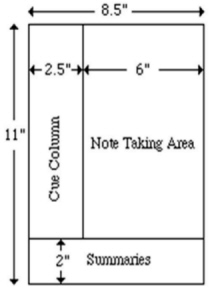
The Cornell Method
image of Cornell Method
The Cornell Method, as illustrated above, divides a page into different sections for different purposes, as described below.
Note Taking Area:
Record the lecture material as fully and as meaningfully as possible.
Make note of the instructors organization of the material (use their outlines and headings, etc.)
Make note of anything given special emphasis by the instructor.
Use some kind of special symbol to mark what the instructor emphasized.
Use shorthand and abbreviations as much as possible, as long as you are certain you will recognize and understand your own notes at a later date.
Adapt your note-taking style to the teaching style of the instructor.
Cue Column:
As you're taking notes, keep the cue column empty.
As soon as practical after the lecture, reduce your notes to concise points as clues for Reciting, Reviewing, and Reflecting.
In other words, use the cue column to highlight the most important ideas and concepts from your notes, as you have discerned from the material itself and its presentation.
The cue column will serve as an index and highlighter to help you find the information in the main part of your notes at a later time.
Summaries Area:
After you have filled in the cue column, use this area to sum up each page of your notes in a sentence or two.
You can list a short description of the most important ideas on that note page in summary statements which are as short as possible to clearly communicate the idea.
The "5 R's"
Record:
During the lecture, record in the main column as many meaningful facts and ideas as you can.
Write as legibly as you can.
Reduce:
As soon as possible after the lecture, summarize these facts and ideas concisely in the cue column.
Summarizing clarifies meanings and relationships, reinforces continuity, and strengthens memory.
Recite:
Cover the note taking area. Then using only your writing in the cue column, recite the facts and ideas of the lecture as fully as you can, not mechanically, but in your own words.
Then, verify what you have said and review anything you missed.
Reflect:
Draw out your opinions and reactions to the material from your notes and use them as a starting point for your own reflections on the course material and how it relates to other material you have already learned.
Reflections will help prevent ideas from being inert and soon forgotten.
Review:
Spend a short time every week in quick review of your notes, and you will retain most of what you have learned.
trigger icon
Reading & Retention
Click Here to  close open

Click the plus and minus icons with each item below to see more or less information

Or you may push the buttons below to expand or collapse the every item at once:

Read with purpose
Determine why you are reading the material and what you need to do with the information.
Do you need to master the material for an exam?
Do you need to get an overview of the book for a book report?
Are you researching for a paper and only need certain details?
Read at the speed and depth appropriate to fulfill your purpose in reading.
Don't read everything at the same speed.
Some material should be read carefully and in detail.
Other material needs to be just skimmed until you get to the part that requires more detailed reading.
When doing research, learn to use the table of contents and index, so that you only read the parts that are necessary for your topic.
Survey:
Start by surveying what you are about to read.
Look at major headings, charts, and pictures (including picture captions).
Read the summary and study questions.
Read the first and last paragraph in the section or chapter.
Read the first sentence in each paragraph or section.
Think about what you already know about the subject.
Comparing the reading with what you already know helps to cement it in long-term memory.
Question:
Read actively and ask questions of the material. For example:
"What does the author mean by this?" (look up any words you don't know)
"Why did the author include this material?"
"Is this statement true and accurate?"
"How does it compare to what I already know about this subject?"
"How does this material apply to my life and ministry?"
etc.
You learn the most when you 'argue' with an author:
This means mentally having a conversation about the material and clarifying it in your own mind.
Ask the reasons and evidence for the ideas the author is advocating.
Ask yourself about any presuppositions that underly the author's statements. Ask whether they are valid or not.
Ask if the author has given sufficient reasons for you to believe the things they are teaching.
Don't do this with a negative skeptical attitude. But do this in order to be clear in your own mind what the author is teaching and the evidence they have given for what they have written.
Follow the truth wherever it goes. And be clear about how strong a case the author is making for what they have written.
Notate:
Read with a pencil (or highlighter, etc.) in hand.
Do not primarily mark just those things you find interesting or the things you agree with.
Instead, at the end of every paragraph, determine what was the main point of the paragraph and mark that information.
Mark any key facts (names, dates, etc.) with a different kind of mark.
mark any material on which you have questions to which you will later return.
Highlight any major structural markers ("In conclusion," "First..., Second..., finally...," "Therefore," etc.)
NOTE - Only do this in books you own, not in borrowed books!! If a book is borrowed, you can do the same type of notation on your own paper.
Some electronic reading devices allow some forms of notation and/or highlighting. Take advantage of them if you prefer to read electronically, but be certain that these notations can be saved and remain with the file so that you can see them at a later time.
The exact marks you use is not as important as that you use consistent marking conventions, so that you will understand the significance of the marks when you see them later. As long as the marks make sense to you and are consistently used, and help you to understand and notate the reading, use whatever marking style you like.
Summarize:
At the end of each section, paragraph, or chapter (depending on the material and on your own style/preference), summarize the section in your own words in the margin of the text.
Try to think like the teacher writing an exam and ask what you should know from the section.
Write any key words or facts you will want to later study in more detail.
Write yourself study questions from the material.
For large chapters or sections, writing an outline of the material can sometimes be helpful.
If you can't recite the main point(s) after reading, read it again.
Review:
At the end of your study session, briefly go back over all of your summaries, notations, and study questions.
This will help cement the material in your memory.
Regularly review the material, but don't necessarily reread the material. Only read your notations and summaries.
Quiz yourself on the material from the study questions you have prepared and any study questions/guides given in the text or course material.
Research:
When reading for a research paper or project, start with the Table of Contents and Indexes.
Don't read all of the material, just skim quickly, looking for material relevant to your topic.
When you find relevant material, read carefully, taking notes as you read
Make sure you notate any bibliographic information you will need for future use.
trigger icon
Studying & Memorization
Click Here to  close open

Click the plus and minus icons with each item below to see more or less information

Or you may push the buttons below to expand or collapse the every item at once:

Study soon after class
Research shows that reviewing as soon as possible after a lecture or reading session helps to cement the information in your brain.
It may not always be possible to do so immediately afterward, but ideally it will be done as soon as practical.
The more time that passes between initial learning and review, the greater opportunity to forget the information and have to relearn it.
Therefore, it is actually more efficient and effective to review as soon as possible.
Study in small chunks
Distribute your learning over time.
This is much more effective than extended cramming sessions.
Set a time limit, but be consistent.
Take small breaks to refresh yourself and regain focus, but return quickly to study to retain the momentum and motivation of learning.
Study in a consistent time and place
Don't underestimate the power of routine and habit.
Put these things to work for you, and not against.
Set aside a time and place that is dedicated to study.
This helps remove distractions.
Study in a good environment with good lighting
Find a place away from distractions
Have everything you need right there
Make sure your study place is comfortable, but not too comfortable!
Set it up in a way that helps keep you focused without distractions or interruptions.
Make sure you have proper lighting that will protect you from fatigue or eye-strain.
Study according to your learning style
Know yourself and what works best for you.
Use memory cues:
Different cues are appropriate for different subjects and are more or less helpful for different people.
Mnemonic devices such as acronyms (words where each letter stands for a word e.g. NASA)
Pictures that symbolize aspects of the material to be learned (Walk through the Bible has excellent examples of this)
Sound alike words or concepts, e.g. the Greek word for "heart" is kardia from which we get the word "cardiologist" which is a heart doctor.
Old fashioned flash cards are helpful to learn and review many types of information.
Practice restating or writing out the material to help rote memory.
Restating concepts in your own words is extremely helpful for learning.
Reciting the material out loud - "vocalizing" is helpful for many people.
Recording yourself saying course material and listening to the recording is helpful for many people.
Likewise, writing out the material and then reading it is one of the more helpful ways to learn.
Probably the most effective way to learn material is to pretend that you are going to teach the material to someone else. Think through how you would explain and present the material to someone else, and this will cement the ideas into your brain.
Ensure meaningfulness
Truly grasping and understanding something will help you to memorize it much easier than trying to just memorize it by rote.
Fit the material into your present frame of reference.
In other words, connect it to something you already know.
If it is a Bible story, is it before or after another story you already know?
How does it fit into the overall story of the Bible?
etc.
Organize the material in a way that makes sense to you.
If you were teaching the class, how would you explain the material?
That is the organization you can use to help learn the material.
Review with a study buddy
Explaining the material to someone, and vice-versa is a great way to solidify learning.
It is also helpful to fill in the gaps and check the accuracy of your learning (not to mention motivation and mutual encouragement).
Review by recitation and explanation
Put it in words your little brother could understand.
If you cannot explain it, you haven't learned it well enough.
Think Application
Think about how you can use the material in your life.
It is easy to think "I will never use this stuff." That is a guarantee that you will not learn it very well.
But if you force yourself to think about how the material is valuable (ask yourself why the teacher included the material), it helps you to understand and learn the material.
For example, learning about CPR is not exciting unless you think about how you may be able to use it to save someone's life. Then as you visualize an emergency situation and what you would do, you are strengthening your learning of CPR techniques.
If you cannot imagine how the material could be useful, that is a good indication that you don't yet understand the material as well as you should. The application is an important part of the knowledge of something. If that knowledge is lacking, the knowledge is incomplete.
trigger icon
Taking Exams
Click Here to  close open

Click the plus and minus icons with each item below to see more or less information

Or you may push the buttons below to expand or collapse the every item at once:

General Tips
Your success on the test depends mostly on your success of studying throughout the term.
When taking an exam, be well rested and not in a caffeine stupor.
Before the exam, take time to relax. Don't panic. God will still love you at the end of the exam, no matter what the outcome.
Read all directions CAREFULLY!
Quickly look through the exam in order to be familiar with the types of questions and plan about how much time you expect to use to answer each section.
Plan your time.
Answer the easiest questions first.
Read each question carefully and make sure you understand what is being asked before answering it.
Don't rush.
Check you work. Make sure you answered everything.
Unless there are points deducted for an incorrect answer, DON'T LEAVE ANY QUESTIONS BLANK. Any answer is better than no answer.
Tips for Essay Tests
Read the question carefully.
Plan your time.
Make a brief outline and brainstorm pertinent information.
Understand the question - i.e. "list..." requires a different type of answer than "define..." or "explain...", etc.
Get to the point:
Include the fact(s) the instructor is looking for.
You don't need to restate the question or give a flowery introduction.
If you are trying to bluff or BS, the instructor will almost certainly know, and it will likely count against you.
If writing by hand, be as neat as you can.
Leave room to expand your answers, and come back if you think of something to add before the end of the exam.
Read through and check your answers. Edit if necessary.
Tips for Objective Tests
Answer every question.
Read the questions carefully and watch how the questions are worded.
Watch for qualifiers on T/F questions - e.g. "always," "never," "primarily," etc.
Watch for modifiers on T/F questions - e.g. "most," "only," "first," etc.
Watch out for multiple concepts on T/F questions. All parts must be true.
On multiple choice questions, eliminate answers you know for certain are not correct. Then it will be easier to concentrate on the remaining possibilities.
On matching questions, start with the items you are most sure about and then work to the more difficult items.
trigger icon
Research & Writing
Click Here to  close open

Click the plus and minus icons with each item below to see more or less information

Or you may push the buttons below to expand or collapse the every item at once:

Gather Resources
Use the best resources, not just the most convenient.
Learn to discern what is best quality and most helpful.
Search:
Search and find as many relevant resources as possible.
The first task is to FIND the resources, later you will cut it down to the best resources to use. But first you must find all the possible resources that are available.
Start with any bibliographies included with the course and from any course textbook.
Your instructors and knowledgeable friends/peers may also be able to recommend great resources.
Use library searches, internet searches, and bibliographies from other resources and courses.
There are different types of resources to search for:
Books:
Books are still the best resource for most research.
They represent long term research and relevance.
Most books, especially by reputable publishers have been vetted (assessed by someone who has decided it is worth investing in) and edited.
This vetting and editing process typically produces higher quality and more reliable materials.
The disadvantage of books is that the longer production process means they may not be completely up to date on some rapidly changing topics.
Periodicals:
Periodicals are typically more up to date and current than books (at the time when they were first published).
They are vetted and edited, which gives a level of quality to periodicals. However, the process is typically quicker than books, so that the quality control is not as thorough as for books.
The weakness of periodicals is that information is not yet proven. Academic ideas are often put forward in periodicals first. And some of these ideas are shown to be faulty when others respond to those ideas after they are first published.
A/V resources:
There are a variety of audio/visual teaching materials. And therefore, there is a wide spectrum of quality and trustworthiness.
Materials produced for commercial sales typically have better quality and higher standards, because of the investment to produce them.
Online/Electronic:
Online and electronic resources are even more varied in content and quality
There are many excellent online resources. However there are also many horrible resources and falsehoods found online.
Therefore, you need to be careful and discerning when using online resources.
Many online resources are not vetted, edited, or produced by people with the qualifications to produce trustworthy material.
There are also many spoof and satire sites, as well as many sites produced by those who have an interest in distorting the truth for some selfish purpose instead of documenting and publishing the truth.
It is a sign of our times that the line between truth and falsehood is often purposely blurred.
However, the average quality of online resources is getting better all the time. Yet there is still a need to learn to differentiate the quality resource from the wackos and all in between.
Taste:
When reading for a research paper or project, start with the Table of Contents and Indexes.
Get a taste for the resource and what it contains.
Weed Out:
Quickly choose those resources that will be the most helpful.
And weed out the rest.
Don't waste your time with inferior resources. Choose the best available.
Don't just use the first resources you find, or the most convenient. Chose the best available.
Skim:
Don't read all of the material at this time. Just skim quickly, looking for material relevant to your topic.
Note which resources have the best and most relevant information for your research.
Weed Out Again:
Then weed out the resources again.
Determine which resources are the best and therefore will be your main research materials.
And note which resources will be only supplemental for specific items or not used at all.
Read and Make Notes
Read at different speeds.
Don't read all of the material carefully.
Just skim quickly, looking for material relevant to your topic.
When you find relevant material, read carefully, taking notes as you read.
Index card notes are helpful because of the ability to rearrange them later.
Or use a computer system that lets you easily and quickly rearrange notes, e.g. OneNote or Evernote.
Put one fact in one place, and keep your facts separate.
Don't put multiple facts in one place because that limits your ability to rearrange the facts later.
Make sure you notate any bibliographic information for future use.
With each fact, note its source.
In a separate place, notate the full bibliographic information for each source.
It is important to document and correctly cite your sources.
You should avoid any hint of plagiarism like a festering bucket of dog-snot.
Organize and Write
Brainstorm:
List the facts you have put into your brain, without looking at your notes at first.
Quickly getting down what you have learned in research off the top of your head will often give you a decent coverage of the most important points on the topic.
Then review your notes if necessary to complete the brainstorm of important information and anything you missed.
Outline:
Organize the list of what you have learned from your research.
Put the information into logical categories and try to order those categories so that it displays the most natural development of the topic.
Shuffle Cards:
Using the note cards or computer notes you gathered from your research, reorder and group the notes based on the outline categories you have made.
Put the notes in the order of the outline.
Based on the outline, you may decide to leave out some notes/facts that don't fit well in the outline you have brainstormed.
Alternately, you may wish to rework your outline to better account for and organize the facts you have gathered.
And you may also decide to do more research if you don't have enough data to support one or more of the points you have planned in your outline.
Let the facts determine your outline and let your outline organize your facts.
Write Topic Sentences:
Write topic sentences for each major section and then subsection, based on the outline and the facts from your research for that subsection.
A topic sentence is a sentence that simply states or summarizes the facts that are covered in that overall section or subsection, which will be developed in the rest of that section or subsection.
If you cannot yet summarize what will be covered in the section, you have not yet researched and organized your notes sufficiently.
Feel free to adjust your outline and/or reshuffle your facts to better fit the organization that emerges as you work through the material.
Once the subsections and major sections are organized and you are satisfied with your overall outline, write a topic sentence for the entire project, which matches the outline and briefly states what will be covered in the entire project.
Fill in Randomly:
Write in whichever order you choose, filling your outline and writing out your project in full prose, explaining and elaborating on each fact.
Write from fact to fact, using your organized notes to guide your writing.
Make sure to write appropriate transitions from section to section, and between subsections.
Make sure to demonstrate the connection between the facts and flesh out the flow of thought from your outline.
Typically, the introduction and conclusion of the project should be written last, after the body of the project has been substantially completed.
The introduction should attempt to explain what the project will cover in a way that will grab the reader's attention.
The conclusion should summarize what was covered and wrap up the project in a meaningful way.
The format and content of the introduction and conclusion should be based on the topic and content of the project.
Edit and Rewrite:
Editing and rewriting is an extremely important step.
Don't shortcut this step.
Proofread your project and make any necessary changes and corrections.
Once your first draft is complete, it will be easier to see any inconsistencies and incompleteness in what you have written as you proofread it.
Make sure to leave time to proofread and rewrite your project.
You can have a friend or mentor help you with this step if needed.
Listen to another person's feedback and suggestions for improvement. But do not put forward their ideas as your own without clearly citing any help you received that significantly contributed to the final content and/or presentation of your project.
trigger icon
Tracking Your Progress
Click Here to  close open

Click the plus and minus icons with each item below to see more or less information

Or you may push the buttons below to expand or collapse the every item at once:

Keep track of your time spent.
You should not be fanatical about tracking your time down to the minute. Rather, you should be aware of the general amount you are spending on various activities.
A journal of how you spent your time over a week can be a valuable tool to help schedule the next week.
Compare your actual time spent with your schedule.
Determine where you were faithful to your schedule and where you slacked off.
Note where your scheduled time was accurate and adequate and where too much or too little time was alloted.
For instance, did your reading take you as long as you expected?
Are you as far along on a project as you expected?
What type of interruptions took place, which set your schedule back?
Be honest, realistic, and reschedule according to priorities.
Determine which things need more study time? Which need less?
Is there anything that is being neglected?
If reading takes longer than expected, how can you find more time to read? Or how can you read more efficiently?
If it takes less time, what will you do with the extra time?
etc.
Look at feedback
Feedback on assignments and exams should be a good indicator of how you are doing.
The grade should tell you a lot.
Most importantly, the feedback will give you an indication of what things you have mastered and what things you need to go back and review in order to learn it more thoroughly.
Also look for any comments or instructions from the instructor that will help you to do better the next time and cement the material from the assignment.
Always strive to do better by looking for specific ways to improve.
Clarify expectations with Instructor
If you are unsure what to do, how to do it, or what standard you are supposed to meet, feel free to ask the instructor.
However, before going to the instructor, you should read (reread) the syllabus and assignment instructions carefully, because the answer is probably contained there.
Ask Instructor for tips
The instructor has most likely already learned the material and they may have valuable insight into how it can be mastered.
Again, pay close attention to any study guides given by the instructor.
Adjust your schedule and study methods
Based on what you have noticed from your schedule and feedback, make the necessary adjustments to improve your efficiency and effectiveness each week.
Always adjust according to the material to be learned, the instructor expectations, your own learning expectations, your priorities, and you personal learning style.
In essence, you are learning how to learn better.
If something did not work to your expectations, tweak it until you are an expert student, able to learn anything.
trigger icon
Final Advice
Click Here to  close open

Click the plus and minus icons with each item below to see more or less information

Or you may push the buttons below to expand or collapse the every item at once:
Don't lose God in education.
Never let education be a substitute for faithful involvement in a local church and faithful private devotional habits.
Take advantage of fellowship, ministry and discipleship opportunities and mentoring/accountability structures.
Take time to interact with Jesus about every part of your life.
Specifically, invite the Lord to teach and lead you in the course material.
The Bible was written out of lives of prayer, worship, devotion, and wisdom's wrestling with life and the mighty acts of God. It would be a tragedy and violation of the Bible if you treated study of the Bible as merely an intellectual exercise.
I also hope that you learn to rely on Him for the strength to learn and grow and fulfill all of the expectations placed on you in your education.
"Do not pray for easy lives; pray to be stronger people! Do not pray for tasks equal to your powers; pray for powers equal to your tasks. Then the doing of your work shall be no miracle, but you shall be a miracle. Every day you shall wonder at yourself, at the richness of life which has come to you by the grace of God." - Phillips Brooks.
It's about learning and growth, not just grades.
Regularly remind yourself why you are taking courses and learning.
You are growing toward the person God has called you to be.
Remind yourself how much you have accomplished by your education - the challenges you have overcome, and the growth in grace.
Remind yourself of how much you still want to accomplish - the various ways you desire to continue to learn and grow, and the things you want to accomplish using this knowledge.
It's about learning how to learn and becoming a life long learner.
It's about growing in grace and discipline.
The degree at the end is just the beginning.
Don't think that when you finish a course or a program that you can stop studying.
God has called all Christians to be life-long learners.
After the end of a course is the time to start exploring the bibliographies and to go further in what you have learned.
It is time to start exploring the subjects closest to your heart and passions, but with the same intensity and discipline as in school.
Don't sell your books or throw away your notes.
They are an excellent resource for further study and review.
You will be reminded of something from a class you want to refresh.
You should be able to go back to that material.
Don't ever give up
Keep your eye on the prize. Remind yourself of the reason and purpose for your education.
I know study can be difficult at times.
If it were easy, everyone would be doing it.
Remember that God called you to grow in knowledge and wisdom. He has prepared you for everything that He wants you to do.
In those times where you feel like giving in, take a short break and pray.
Ask God for strength to make it.
Trust Him to provide, and you will be pleasantly surprised what God will accomplish through you.
God never fails.
He can turn every challenge, every hardship, every failure into something that forwards His Kingdom in your life and those around you.
You will never be at a place where God cannot rescue you.
You will never be at a place where God does not love you.
In the end, as you are faithful and obedient to God's calling, it will be so worth it.
Rom. 8:18 - "I consider that our present sufferings are not worth comparing with the glory that will be revealed in us."
Don't just learn about study skills, use them.
Stop now and pray for help to be a better student.
Before you go on to other activities, plan now how you are going to implement these suggestions.
Act now while it is fresh in you memory. Don't put it off.